Saturday, February 16, 2013
Introduction Video
Thursday, January 3, 2013
California Supreme Court rejects lawsuit against Great America over bumper car rides
California Supreme Court rejects lawsuit against Great America over bumper car rides
Posted: 01/01/2013 08:55:46 AM PST
Updated: 01/01/2013 08:55:51 AM PST
Fans of those popular bumper car rides at amusement parks such
as Great America or Santa Cruz's Boardwalk take heed -- you can't sue if that
extra bumping leaves you with a bump on the noggin or some other injury.
The California Supreme Court on Monday ruled that Great America and other
amusement parks cannot be sued for injuries that occur in the jostling of rides
such as bumper cars, finding that such thrill-seeking carries an "inherent risk"
akin to playing a sport.In a 6-1 decision, the Supreme Court rejected the arguments of a South Bay doctor who sued Santa Clara's Great America theme park after she broke her wrist while riding the "Rue Le Dodge" bumper car ride with her son in 2005. The ruling overturned

On the bumper cars at the
Santa Cruz Beach Boardwalk, 2011 (Shmuel Thaler/(Santa Cruz) Sentinel
file)
"The risk of injuries from bumping was inherent in the Rue le Dodge ride, and under our precedents (the park) had no duty of ordinary care to prevent injuries from such an inherent risk of the activity," Justice Kathryn Mickle Werdegar wrote for the court.
The Supreme Court in the past has barred lawsuits that occur when people take ordinary risks in sports such as football and skiing, under the legal theory that there is "an assumption of risk" in such activities. Great America's lawyers argued that a bumper car ride falls in a similar legal category, and the Supreme Court agreed.
The Supreme Court has found roller coaster operators have a substantial obligation to ensure safety, but the bumper car case presented different legal circumstances that would have made park owners more vulnerable to lawsuits. A host of recreation businesses, from the ski industry to health clubs, backed Great America in the case.
Justice Joyce Kennard dissented, agreeing with the lower court's finding that a jury should decide whether Great America was negligent in failing to take steps to prevent bumper car head-on collisions.
The lawsuit was filed by Smriti Nalwa, identified in court papers as a San Jose doctor who took her young son and daughter to Great America in July 2005. Court papers show that Nalwa was one of 55 people injured on the bumper car ride among hundreds of thousands of riders over a two-year period, although she was the only patron to suffer a fracture.
In 2006, a year after the accident, Cedar Fair Entertainment, Great America's owners, added an island in the middle to keep bumper car drivers headed in the same direction and minimize head-on collisions, as was done at other parks around the country.
Mark Rosenberg, Nalwa's lawyer, said amusement park owners are now "off the hook" if they operate bumper car rides negligently, even though he insisted consumer safety advocates would try to limit the effect of the Supreme Court's decision.
"Amusement park patrons are less safe today than they were yesterday," he warned.
But Stephen Renick, the park's lawyers, said the Supreme Court established needed legal guidance on whether participating in recreational activities such as amusement park rides should be treated the same as playing a sport.
"It definitely provides clarity," he said. "The courts had gone all over the place on this."
Monday, November 19, 2012

Monday, November 12, 2012
Denied Life Insurance?
Life Insurance Denial
When you purchased life insuranc you purcahsed is as a safety net (honestly, you hoped you never had to claim it). We hope that nothing will happen to us or our loved ones, but in the event that it does, we want those near us not suffer financial hardship.
But when an insurance company sells you a policy, it as a gamble. They have a system called an actuarial table, that virtually guarantees they will win overall. Just take a look at the record profits posted by major insurance companies in recent years and you will notice thier system works (works very well, to be honest). However, insurance companies are not satisfied with just winning—they want to win big, which they do by looking for an excuse to deny every claim, including yours.
One of the most common tactics life insurance companies use to deny your claim is accusing you or your loved one of making a "material misrepresentation" on your application for the policy. Often they will claim your loved one misrepresented his or her:
In these cases, the material misrepresentation is ripe for legal argument. As an experienced life insurance attorney I can make sure the policy is honored even in the face of such claims by the insurance company.
With a lawyer on your side, the insurance company must follow all the rules (both legally and contained within the policy) thereby assuring you will not have to suffer from a "blanket denial."
First if you have lost a loved one, let me be the first to state that I am sorry for your loss. Second, if you have received a denial from your life insurance carrier, or expect one, call the Attorney at RAXTER LAW at (951) 226-5294.
The consulation is FREE and most cases are accepted on a contingency basis - which means no recovery no fee. We represent client in all of southern california.
But when an insurance company sells you a policy, it as a gamble. They have a system called an actuarial table, that virtually guarantees they will win overall. Just take a look at the record profits posted by major insurance companies in recent years and you will notice thier system works (works very well, to be honest). However, insurance companies are not satisfied with just winning—they want to win big, which they do by looking for an excuse to deny every claim, including yours.
One of the most common tactics life insurance companies use to deny your claim is accusing you or your loved one of making a "material misrepresentation" on your application for the policy. Often they will claim your loved one misrepresented his or her:
- Age
- Alcohol, drug, or tobacco use
- Occupation
- Employment history
- Dangerous hobbies, pastimes, or behavioral traits
- Ownership of other life insurance policies
In these cases, the material misrepresentation is ripe for legal argument. As an experienced life insurance attorney I can make sure the policy is honored even in the face of such claims by the insurance company.
With a lawyer on your side, the insurance company must follow all the rules (both legally and contained within the policy) thereby assuring you will not have to suffer from a "blanket denial."
First if you have lost a loved one, let me be the first to state that I am sorry for your loss. Second, if you have received a denial from your life insurance carrier, or expect one, call the Attorney at RAXTER LAW at (951) 226-5294.
The consulation is FREE and most cases are accepted on a contingency basis - which means no recovery no fee. We represent client in all of southern california.
Sunday, November 11, 2012
Happy Veterans Day!
Happy Veterans Day!
Just a side note - We proudly give discounts to Military YEAR ROUND!

Just a side note - We proudly give discounts to Military YEAR ROUND!

Sunday, November 4, 2012
Estate and Lifetime Gift Tax set to expire
If Congress doesn’t act, the estate and lifetime gift tax exemptions, which are currently $5.12 million per person and $10.24 million per married couple, will expire at the end of 2012 and return to $1 million per person and $2 million per married couple in 2013...
Monday, October 29, 2012
School District can be sued for negligent hiring when employee abused a student
Recently the California Supreme Court decided in C.A. v. William S. Hart
Union High School District (2012) 53 Cal.4th 861.
In this Case the court held that a school district under Section 815.2 of the Government Code could be held liable for negligent hiring and/or supervision which resulted in the plaintiff being sexually harassed and abused by a counselor. Factually, the case involved a high school counselor who harassed and abused a student. The student sued, and the superior court and Court of Appeal held that the school district could not be held vicariously liable for the counselor’s misconduct, which was outside the scope of her employment, and also could not be held liable under a negligent hiring or supervision claim. The Supreme Court unanimously reversed, permitting the plaintiff to move forward with his claim that the district can be held vicariously liable for the negligence of supervisory or administrative personnel who allegedly knew, or should have known, of the counselor’s propensities and nevertheless hired, retained and inadequately supervised her. The court reasoned that because school personnel owe students under their supervision a protective duty of ordinary care, if a supervisory or administrative employee of the district is proven to have breached that duty by negligently exposing the plaintiff to a foreseeable danger of molestation by his guidance counselor, liability may be imposed.
The Government Code does not protect school districts when they negligently hire a employee who harasses and abuses a child.
Contact RAXTER LAW today for a confidential free consultation at (951) 226-5294.
In this Case the court held that a school district under Section 815.2 of the Government Code could be held liable for negligent hiring and/or supervision which resulted in the plaintiff being sexually harassed and abused by a counselor. Factually, the case involved a high school counselor who harassed and abused a student. The student sued, and the superior court and Court of Appeal held that the school district could not be held vicariously liable for the counselor’s misconduct, which was outside the scope of her employment, and also could not be held liable under a negligent hiring or supervision claim. The Supreme Court unanimously reversed, permitting the plaintiff to move forward with his claim that the district can be held vicariously liable for the negligence of supervisory or administrative personnel who allegedly knew, or should have known, of the counselor’s propensities and nevertheless hired, retained and inadequately supervised her. The court reasoned that because school personnel owe students under their supervision a protective duty of ordinary care, if a supervisory or administrative employee of the district is proven to have breached that duty by negligently exposing the plaintiff to a foreseeable danger of molestation by his guidance counselor, liability may be imposed.
The Government Code does not protect school districts when they negligently hire a employee who harasses and abuses a child.
Contact RAXTER LAW today for a confidential free consultation at (951) 226-5294.
Tuesday, October 23, 2012
Eminent Domain in Southern California
Under the law of eminent domain, municipal, state or federal governmental bodies have the right to take private land for public use. The power of eminent domain is used for public projects such as schools, government buildings, utilities, or transportation systems and highways. Eminent domain laws also give property owners the right to fair compensation and other remedies.
At the Southern California law office of RAXTER LAW, we protect the rights of residential and commercial property owners and displaced commercial tenants or business owners in the Riverside and San Bernardino County area and throughout Southern California.
If you have received notice from the condemnor of a Resolution of Necessity hearing, our office can represent you at that proceeding. If the condemning agency has made an offer to you that you believe is too low, we can help you obtain your own appraisal and negotiate for fair market value.
Did you know that California law requires that the condemning government agency pay the property owner up to $5,000 for their own appraisal?
California Eminent Domain law is set forth in the California Code of Civil Procedure.
 Contact RAXTER LAW for a FREE CONSULTATION regarding your eminent domain matter. Give us a call at 951-226-5294. We look forward to speaking with you.
At the Southern California law office of RAXTER LAW, we protect the rights of residential and commercial property owners and displaced commercial tenants or business owners in the Riverside and San Bernardino County area and throughout Southern California.
If you have received notice from the condemnor of a Resolution of Necessity hearing, our office can represent you at that proceeding. If the condemning agency has made an offer to you that you believe is too low, we can help you obtain your own appraisal and negotiate for fair market value.
Did you know that California law requires that the condemning government agency pay the property owner up to $5,000 for their own appraisal?
California Eminent Domain law is set forth in the California Code of Civil Procedure.
Sunday, September 16, 2012
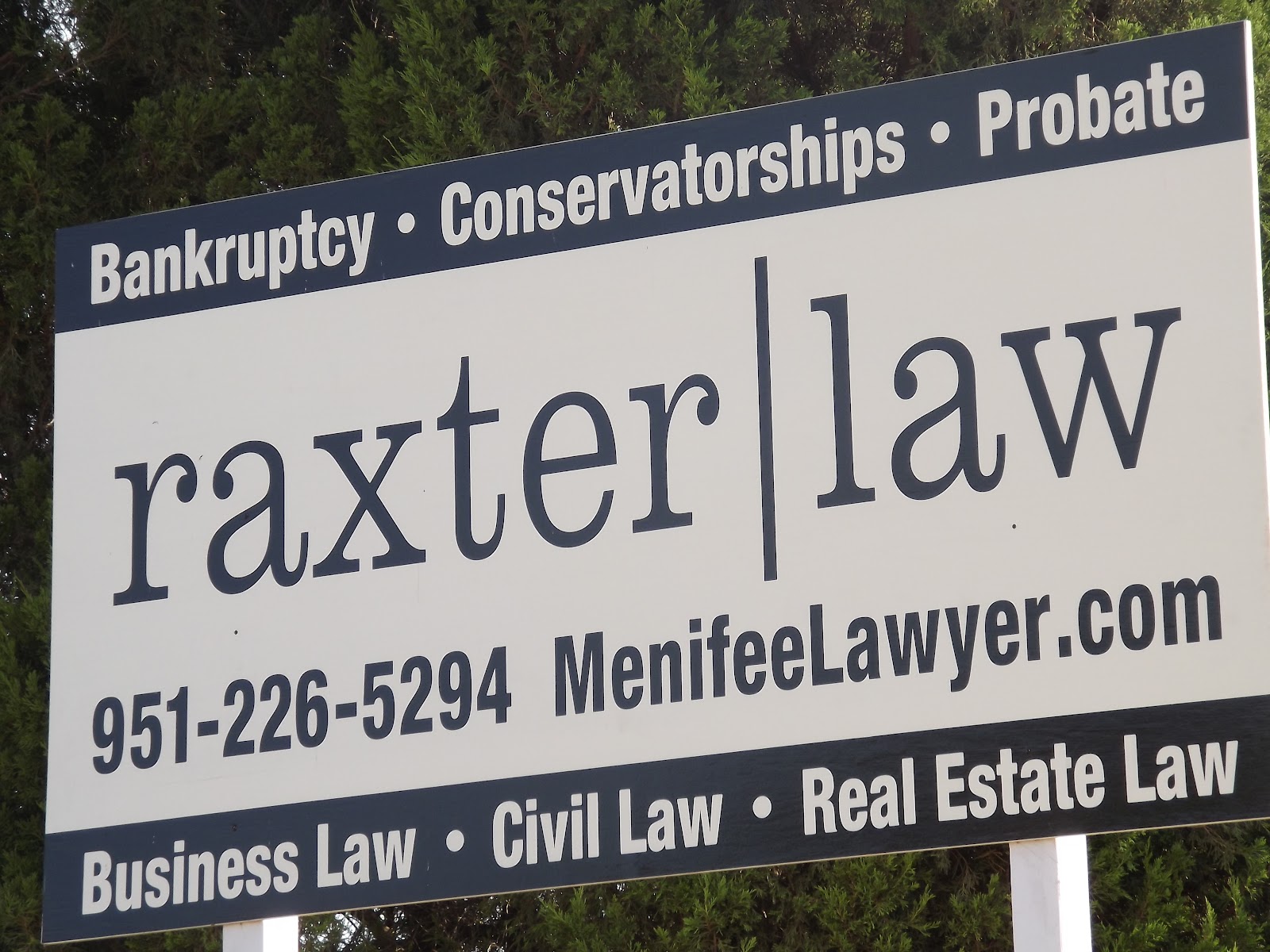
Sign
 |
| Menifee Lawyer, Sun City Lawyer, Menifee Attorney, Menifee Law Office |
Jarrod Townsend of All Pro Signs. He is local, professional, and a true artist. You can reach him at 951-324-3289.
Tuesday, September 4, 2012
Scams - If it is too good to be true...well you know!
I was planning to write an article covering the topic of conservatorships, however, an issue was brought to my attention this month that is of a more pressing nature. This month alone approximately ten clients have been the attempted victims of a scam. Luckily, none became actual victims. So, let me use this opportunity to discuss a few of the common scams that are running rampant as of today.
First- We all know about the “lottery scam” where a party, company, whoever tells you won a lottery. A lottery that is, that you never entered. That fact seems to elude most people. In order to claim the “prize” you must send money ahead of time (either for taxes, processing fees, etc). Well, you see where this is going. I suppose the first thing we must remember never (I mean never) send money via Western Union without personally knowing the recipient.
Second- This scam is fairly new and prevalent in our area. Scammers will often try to take advantage of the increased vulnerability of senior citizens who have recently lost a loved one. In one recent example, scammers would find targets by scouring the obituaries. They would then call the widow or widower and claim that their spouse had outstanding debts that needed to be paid immediately. Victims would then be persuaded to provide a blank check or credit card. Never fall victim to this scam. The reason probate was created was to protect creditors.
Third- This one is not per se illegal but still doesn’t pass the “smell test”. In this case, a very official letter arrives in the mail telling you that you “must send money in order to receive a certified copy of your deed” and that you must have a copy of your deeds in order to prove legal title. The letter I reviewed last month requested nearly $200.00 for this “service”. Please, understand that the reason the county recorder is around is to maintain the official property records of the county (among other things). In fact, if you would like a copy of your deed all you have to do is request one from the Recorder for a cost of less than $20.00.
No one is immune from scammers. In fact, as I type this article I am looking at a “certified cashiers” check that arrived in the mail from the Caribbean for a substantial sum for a client my office never represented. All “they” want in return is a large amount of personal information….so, if the check clears this may by my last article.
If you receive something in the mail, or a deal seems too good to be true, it probably is. When in doubt, have an adult child, a family friend, or a professional review any offer before signing. For more information regarding scams please visit www.raxterlaw.com/scams Good luck.
Do not be a victim, knowledge is power.
http://www.menifeebuzz.com/index.php?option=com_content&view=article&id=610:scams--if-its-too-good-to-be-truewell-you-know&catid=36:general&Itemid=149
First- We all know about the “lottery scam” where a party, company, whoever tells you won a lottery. A lottery that is, that you never entered. That fact seems to elude most people. In order to claim the “prize” you must send money ahead of time (either for taxes, processing fees, etc). Well, you see where this is going. I suppose the first thing we must remember never (I mean never) send money via Western Union without personally knowing the recipient.
Second- This scam is fairly new and prevalent in our area. Scammers will often try to take advantage of the increased vulnerability of senior citizens who have recently lost a loved one. In one recent example, scammers would find targets by scouring the obituaries. They would then call the widow or widower and claim that their spouse had outstanding debts that needed to be paid immediately. Victims would then be persuaded to provide a blank check or credit card. Never fall victim to this scam. The reason probate was created was to protect creditors.
Third- This one is not per se illegal but still doesn’t pass the “smell test”. In this case, a very official letter arrives in the mail telling you that you “must send money in order to receive a certified copy of your deed” and that you must have a copy of your deeds in order to prove legal title. The letter I reviewed last month requested nearly $200.00 for this “service”. Please, understand that the reason the county recorder is around is to maintain the official property records of the county (among other things). In fact, if you would like a copy of your deed all you have to do is request one from the Recorder for a cost of less than $20.00.
No one is immune from scammers. In fact, as I type this article I am looking at a “certified cashiers” check that arrived in the mail from the Caribbean for a substantial sum for a client my office never represented. All “they” want in return is a large amount of personal information….so, if the check clears this may by my last article.
If you receive something in the mail, or a deal seems too good to be true, it probably is. When in doubt, have an adult child, a family friend, or a professional review any offer before signing. For more information regarding scams please visit www.raxterlaw.com/scams Good luck.
Do not be a victim, knowledge is power.
http://www.menifeebuzz.com/index.php?option=com_content&view=article&id=610:scams--if-its-too-good-to-be-truewell-you-know&catid=36:general&Itemid=149

Tuesday, May 22, 2012
Saturday, March 17, 2012
MOVING TO A NEW OFFICE
 |
| Wildomar Lawyer - Attorney has moved to a new office |
Raxter Law
27851 Bradley Rd, Suite 145
Menifee, Ca 92584
(951) 226-5294
Our phone number remains the same. The new office will allow us to provide better service and bis better suited to evening apppointments.
Stop by and say hello!
Sunday, February 5, 2012
2 New types of Corporations
As of January 1, 2012, there are two new subtypes of stock corporations in California — a
“flexible purpose corporation” and a “benefit corporation.” The new corporation subtypes allow
entrepreneurs and investors to organize stock corporations that can pursue both economic and
social objectives. The new stock corporation subtypes differ from traditional for profit
corporations that are organized to pursue profit and nonprofit corporations that must be used
solely to promote social benefits.
Friday, December 23, 2011

Thursday, December 22, 2011
New laws that take effect in 2012 that every employer or business should know.
New laws that take effect in 2012 that every employer or business should know.
Several new employment laws will impact California employers’ day-to-day operations and policies in 2012. Unless specified, all new legislation goes into effect on Jan. 1, 2012.
* Credit Check
AB 22 prohibits employers and prospective employers, not including certain financial institutions, from obtaining and using consumer credit reports (credit information) about applicants or employees.
The prohibition does not apply to “managerial positions,” defined as those who qualify for the executive exemption from overtime. This exception reinforces the need to make the correct exempt/nonexempt classification at the time you decide to recruit for an open position.
The prohibition against obtaining and using credit reports also does not apply to the following:
- Law enforcement positions and positions for which the information is required by law
- Positions that involve regular access (other than in connection with routine solicitation and processing of credit card applications in a retail establishment) to bank or credit card information, Social Security numbers, and date of birth
- Positions in which the person is, or would be, a named signatory on the employer’s bank or credit card account, or authorized to transfer money or enter into financial contracts on behalf of the employer
- Positions that involve access to confidential or proprietary information, as defined . Positions that involve regular access to cash totaling $10,000 or more of the employer, a customer, or client during the workday
* Pregnancy Disability Leave
SB 299 requires all employers with five or more employees to continue to maintain and pay for health coverage under a group health plan for an eligible female employee who takes Pregnancy Disability Leave (PDL) up to a maximum of four months in a 12-month period. The benefits are at the same level and under the same conditions as if the employee had continued working during the leave period.
Under current law, employers were only required to provide benefits for pregnancy leave to the same extent and for the same length of time as they would for other temporary disability leaves. If the employer was covered by the federal Family and Medical Leave Act, it had to provide continuing coverage during the twelve weeks of FMLA leave.
The new law requires group health insurance continuation coverage for all employers with five or more employees regardless of how they treat other temporary disability leaves and regardless of FMLA coverage. Employers should review their policies to ensure compliance with this new law.
* Willful Misclassification of Independent Contractors
SB 459 provides new penalties of between $5,000 to $25,000 for the “willful misclassification” of independent contractors. Willful misclassification is defined as: “avoiding employee status for an individual by voluntarily and knowingly misclassifying that individual as an independent contractor.”
The law also imposes joint liability on non-attorney outside consultants who knowingly advise an employer to treat an individual as an independent contractor to avoid employee status.
* Written Commission Agreement
AB 1396 requires employers who have commission pay arrangements to put those agreements into a signed written contract. The written contract must set forth the method by which the commissions will be computed and paid. If the contract expires but the parties keep working under the expired contract, the contract terms are presumed to remain in effect unless superseded by a new contract or the employment relationship is terminated. The bill is effective January 1, 2013. Employers have the entirety of 2012 to bring their commission agreements into compliance.
* Notice of Pay Details
AB 469 requires employers to provide nonexempt employees, at the time of hire, a notice that specifies:
- The rate of pay and the basis, whether hourly, salary, piece commission or otherwise, including any overtime rate
- Allowances, if any, claimed as part of the minimum wage, including meal and lodging allowances
- The regular pay day designated by the employer as required under the Labor Code
- The name of the employer, including any “doing business as” names
- The physical address of the employer’s main office or principal place of business and any mailing address, if different
- The telephone of the employer
- The name, address and telephone number of the employer’s workers’ compensation carrier
The law also requires notice of any other information the Labor Commissioner deems material and necessary. The Labor Commissioner is to provide a template. The new law only applies to nonexempt employees, which again highlights the need for properly classifying employees at the time of hire.
If there is any change to the information in the notice, the employer must notify each employee, in writing, within seven calendar days of the changes, unless such changes are elsewhere reflected on a timely wage statement or other writing required by law.
This legislation also increases penalties for wage violations and makes further changes regarding collection of such penalties, including an increase in the statute of limitations.
* Organ and Bone Marrow Donor Leave
SB 272 clarifies the implementation of California’s organ and bone marrow donor leave law (Labor Code sections 1508-1512). Existing law provides up to 30 days of leave in a one-year period for organ donation and up to five days of leave in a one-year period for bone marrow donation. The new legislation clarifies that the days of leave are business days, not calendar days, and that the one-year period is measured from the date the employee’s leave begins. Existing law stated that employers’ could require use of sick and vacation leave, but did not mention paid time off (PTO). The new legislation clarifies that employers can require the use of a specified number of earned but unused days for PTO.
* Genetic Information
SB 559 amends the Fair Employment and Housing Act (FEHA) to state that employers are prohibited from discriminating against employees on the basis of genetic information. The legislature noted that the range of protection provided by the federal Genetic Information Nondiscrimination Act (GINA) is not complete for California. Also, FEHA applies to employers with five or more employees while the federal law applies to employers with 15 or more employees.
Genetic information is defined as information about any of the following:
- The individual’s genetic tests
- The genetic tests of family members of the individual
- The manifestation of a disease or disorder in family members of the individual.
Genetic information includes: any request for, or receipt of, genetic services, or participation in clinical research that includes genetic services, by an individual or any family member of the individual. Genetic information does not include information about the sex or age of any individual.
This prohibition against discrimination on the basis of genetic information is in addition to the existing state law prohibition against discrimination based on a medical condition, including genetic characteristic.
* Gender Expression
AB 887 amends the Fair Employment and Housing Act to further define “gender” to include both gender identity and “gender expression” and to make clear that discrimination on either basis is prohibited. Current law only uses the term gender identity. AB 887 also amends Government Code section 12949 relating to dress codes to include that an employee must be allowed to dress consistently with both the employee’s gender identity and gender expression.
“Gender expression” is defined as “a person’s gender-related appearance and behavior whether or not stereotypically associated with the person’s assigned sex at birth.” This definition is not a change from existing law relating to gender identity.
* E-Verify
AB 1236 relates to the E-Verify program; a federally created program that allows employers to use an Internet-based system to electronically verify the employment eligibility of newly hired employees.
E-Verify compares Form I-9 documentation against federal government databases to verify employees’ employment eligibility.
AB 1236 allows employers to continue to choose to use E-Verify, but prohibits California state agencies and local governments from passing mandates that require employers to use E-Verify.
Several cities in California passed local ordinances requiring the use of E-Verify in certain circumstances. For example, a Mission Viejo city ordinance requires the city and certain employers with city contracts to verify the eligibility of new employees through E-Verify. This new law prohibits such state or local mandates, unless required by federal law or as a condition of receiving federal funds.
* Interference With Rights Under Leave Laws
AB 592 adds language to the California Family Rights Act (CFRA) and the Pregnancy Disability Leave law (PDL) that makes it unlawful to interfere with or in any way restrain the exercise of rights under these laws. This added language should not be a change to existing employer obligations since this is already a requirement under the federal Family and Medical Leave Act (FMLA).
* Administrative Penalties
AB 240 allows an employee that alleges a minimum wage violation to recover liquidated damages pursuant to any complaint brought before the Division of Labor Standards Enforcement. Existing law allows such damages in any complaint before a civil court, but not in an administrative proceeding before the Labor Commissioner. This new law would allow the Labor Commissioner to also award such damages. Under the new liquidated damages provision, the employee would be entitled to recover an amount equal to the wages unlawfully unpaid, plus interest.
* Wage Penalties
AB 551 increases the maximum penalty from $50 to $200 per calendar day for each worker paid less than the determined prevailing wage and increases the minimum penalty from $10 to $40 per day for violations of prevailing wage obligations. These obligations apply to certain state or federal contracts and generally require a set wage that is significantly higher than minimum wage.
It also increases the penalty from $25 to $100 per calendar day, per worker, against contractors and subcontractors that fail to respond to a written request for payroll records within 10 days.
* Farm Labor Contractors – Wage Notices
AB 243 amends Labor Code section 226 to expand the information that must be included on pay statements, but only for farm labor contractors. Employers that are farm labor contractors must now disclose on the itemized payroll statement furnished to their employees, the name and address of all legal entities (for example other growers or other farm labor contractors) that secured the employer’s services. The bill provides that this listing would not create any legal liability on the part of the legal entity.
* Agricultural Labor Relations
SB 126 affects certification of bargaining representatives for agricultural employees. Existing California law prohibits agricultural employers from engaging in unfair labor practices with regard to agricultural employees electing their labor representatives. Under current law, the Agricultural Labor Relations Board (ALRB) can refuse to certify an election if it determines that employer misconduct affected the election result.
The new law, SB 126, provides that if the ALRB finds employer misconduct that “in addition to affecting the outcome of the election, would render slight the chances of a new election reflecting the free and fair choice of employees,” then the ALRB can certify the labor union as the exclusive bargaining agent for employees.
* Insurance Non-Discrimination Act
Existing California law requires health care service plans and health insurance policies to provide group coverage to the registered domestic partner of the employee or insured equal to the coverage provided to the spouses of employees. SB 757 closes an existing loophole and prevents employers that operate in multiple states from discriminating against same-sex couples by not providing the same insurance coverage for domestic partners as they do for spouses.
The new law provides that every group health care service plan contract and every group health insurance policy that is marketed, issued, or delivered to a California resident is subject to the requirement to provide equal coverage to domestic partners as is provided to spouses, notwithstanding any other provision of law. Under the new law, even if the employer’s principal place of business and majority of employees are located outside of California, no policy or certificate of health insurance marketed, issued or delivered to a California resident shall discriminate between spouses or domestic partners of a different sex and spouses or domestic partners of a same sex.
A willful violation of this provision by a health care service plan is a crime.
* State Contracts – Gender or Sexual Orientation Discrimination
SB 117 outlaws the state of California from entering into contracts of more than $100,000 with companies that discriminate against the employees on the basis of gender or sexual orientation with regard to benefits. Existing law prohibits discrimination between employees with spouses and employees with domestic partners. The new law makes it clear that companies doing business with the state of California cannot deny equal benefits to same-sex spouses.
* Apprentice Programs
SB 56 changes the audit requirements for apprenticeship programs. Currently, the Division of Apprenticeship Standards within the Department of Industrial Relations is required to randomly audit all apprenticeship programs during each five-year period to ensure compliance with specified requirements, including industry-specific training criteria. This new law eliminates the mandate of random audits during five-year increments, and instead directs the Division to conduct audits of apprenticeship programs generally. It also creates requirements for applications for building and construction trades programs for approval of a new or expanded apprenticeship program.
* Safe Lifting – Hospitals
AB 1136 provides that general acute care hospitals must maintain a safe patient handling policy for patient care units, including trained lift teams or training in safe lifting techniques for staff. The safe patient handling policy must be kept in accordance with the California Occupational Safety and Health Act and should be part of the Injury Illness and Prevention Program (IIPP) of these specific employers.
* Workers’ Compensation Legislation
The governor signed these five workers’ compensation bills that were all supported by CalChamber.
- AB 335 – Requires the workers’ compensation administrative director (AD) to work with the Commission on Health and Safety and Workers’ Compensation (CHSWC) to develop regulations regarding notices to injured workers; requires AD and CHSWC to develop and make accessible a booklet written in plain language about the workers’ comp claims process; streamlines and simplifies other notices to employees.
The new law also states that workers’ compensation notices posted by employers must now include the website address and contact information that employees may use to obtain further information about the workers’ compensation claims process and an injured employee’s rights and obligations, including the location and telephone number of the nearest information and assistance officer. The administrative director is required to make available on the department’s website informational material regarding the workers’ compensation claims process, written in plain English.
- AB 378 – Lowers workers’ compensation costs by establishing guidelines for dispensing compound drugs, the circumstances under which those drugs would be covered and the reimbursement amount, and removes the incentives for physicians to refer patients to pharmacies in which the physician or physician’s family has a financial interest.
- AB 397 – Seeks to address the underground economy problem by singling out contractors that do not have workers’ compensation coverage but requiring contractors that are exempt from having coverage at the time they are licensed to certify they are still exempt or have gotten coverage at the time of their license renewal.
- AB 1168 – Lowers costs for employers and insurers by establishing a fee schedule for vocational experts’ services.
- AB 1426 – Streamlines the workers’ comp process and eliminates duplicative bureaucracy and inconsistency by eliminating the court administrator position.
The governor also signed a Workers’ Compensation related bill that CalChamber took no position on:
- AB 228 – Amends California Insurance Code section 11780.5 to authorize the State Compensation Insurance Fund (SCIF) to provide workers’ compensation coverage to a California employer whose California employees temporarily work outside the state and whose injuries while performing out-of-state work might lead to workers’ compensation liability in some other state.
Under existing law, SCIF could rightfully deny coverage for out-of-state workers’ compensation claims, creating the risk of personal injury lawsuits by employees as a result of their employer not having workers’ compensation insurance coverage in place for such injury claims. The new law expands coverage through partnerships between SCIF and other qualifying carriers, who insure workers’ compensation risks in California, and the other states where the California employees are temporarily working.
* DFEH Procedural Regulations
Effective October 7, 2011, the Department of Fair Employment and Housing (DFEH) has instituted new regulations relating to procedures for filing, investigating and processing discrimination and harassment claims. DFEH is the state agency charged with enforcing the state Fair Employment and Housing Act and handling complaints of discrimination and harassment. Overall, the regulations make it easier for claimants to file their complaints and initiate a DFEH investigation.
For example:
- The statute, as written, requires that a complaint filed with the DFEH be “verified.” The new regulations do not require the claimant to sign the complaint. Instead, the complaint can be signed by the claimant’s attorney or other designated representative.
- The DFEH will accept an unsigned complaint if neither the claimant nor an authorized representative can sign it before the statute of limitations expires. The Fair Employment and Housing Commission, which hears cases brought before it by the DFEH, objected to this regulation on the ground that it contradicts the statutory requirement, but the DFEH disagreed and issued the regulation.
- The new procedural regulations allow for liberal construction of complaints.
– For example, if a claimant brings a complaint alleging only discrimination, but the DFEH believes the facts could support retaliation, the DFEH will construe the complaint to allege both discrimination and retaliation even though the claimant did not bring any such claim. As a result, it will be harder for employers to dismiss claims on the ground that the employee never raised the claim before the DFEH.
- The new procedural regulations allow the DFEH to accept complaints that appear untimely on their face and investigate whether the complaint actually was brought within the statute of limitations. This makes it easier for claimants and less likely that employers can have the claim dismissed at an early stage.
For more information on the DFEH regulations, visit www.dfeh.ca.gov.
For all your legal business needs contact RAXTER LAW. Raxter Law provides legal services to businesses in a cost-effective manner. Call today (951) 226-5294
Monday, December 12, 2011
How do I collect a judgment? Judgment Collection
Once a judgment is obtained (either in California, or domesticated from another state or country to California) the judgment-creditor must then take steps to enforce the judgment. A judgment is itself is nothing but a piece of paper. You as the creditor must actively "enforce" the judgment.
The most common remedies and enforcement procedures include:
(1)placing liens on real property owned by the debtor;
(2)levying upon income the debtor may currently have
(3)levying bank accounts.
The attorney at RAXTER LAW can also use different strategies to locate such assets depending on the individual debtor, including judgment debtors’ examination. This is the process where a "debtor" is brought into a court to give sworn testimony relating to thier assets.
In the end, the goal is to collect the judgment you worked so hard to obtain. As you can see this can be obtained in many different way. We prefer to enter into voluntary payment agreements with the debtor, thus reserving the "legal enfrocement" as the last resort. However, you as the judgment creditor are entitled to collect the judgment and our office will work to see that happens.
Raxter Law / Menifee Lawyer enforces judgments for its clients in a low to no cost manner.
If you have a judgment that you would like to have collected, please contact us today.
(951) 226-5294 www.menifeelawyer.com
The most common remedies and enforcement procedures include:
(1)placing liens on real property owned by the debtor;
(2)levying upon income the debtor may currently have
(3)levying bank accounts.
The attorney at RAXTER LAW can also use different strategies to locate such assets depending on the individual debtor, including judgment debtors’ examination. This is the process where a "debtor" is brought into a court to give sworn testimony relating to thier assets.
In the end, the goal is to collect the judgment you worked so hard to obtain. As you can see this can be obtained in many different way. We prefer to enter into voluntary payment agreements with the debtor, thus reserving the "legal enfrocement" as the last resort. However, you as the judgment creditor are entitled to collect the judgment and our office will work to see that happens.
Raxter Law / Menifee Lawyer enforces judgments for its clients in a low to no cost manner.
If you have a judgment that you would like to have collected, please contact us today.
(951) 226-5294 www.menifeelawyer.com
Wednesday, November 30, 2011
Thinking of adding “Inc.” to your business name? Want to incorporate your business?
In general incorporating your business can provide the business owner the following advantages:
 |
| Thinking of Inc.ing your business? |
In general incorporating your business can provide the business owner the following advantages:
Sole proprietorship and partnerships are subject to unlimited personal liability from a judgment arising out of a business debt. Which means, creditors can and will hold the business owner personally liable for debt. If the creditor is successful in obtaining a judgment that can enforce the judgment by seizing or garnishing your personal property such as a home, savings, or other personal assets. The most common way to protect your personal assets from business-related lawsuits is by incorporating your business. No matter the size of your business, it’s worth investing in your business to protect your personal assets. Please take note that incorporation by itself is not sufficient to protect or isolate your personal assets, there are other formalities that must be followed to secure the protection that is offered by incorporating your business.
It is advisable that you contact your local small business attorney before deciding if incorporation is right for your business.
Did you know that a judgment that is awarded against you in favor of a creditor can devastate your personal credit score? Even a small judgment can have major impacts on your credit score. This is another important reason to incorporate your business.
Incorporation can offer some tax advantages. The advantages depend on many factors such as whether the corporation elects to be taxed under subchapter "S" or "C" of the Internal Revenue Code.
Another huge advantage to incorporation is that a corporation “lives forever.” Meaning if a sole proprietor dies the business generally “dies” or ends with the death of the proprietor.
Generally, as a business entity corporations are easier to market and sell to an investor and usually more attractive to buyers than a sole proprietorship.
Incorporation may enhance the “image” of your business by increasing your credibility and prestige in its dealings.
A corporation can offer anonymity. For example, if a business owner wants to have a small business without causing their identify to be public knowledge, the best choice is to incorporate.
Raxter Law is a law office concentrating on the needs of Small Business. If you have any questions contact Raxter Law at (951) 226-5294.
Tuesday, November 29, 2011
Mobile Billboards can now be regulated by the local government
Mobile Billboard Advertising Displays (AB 2756)
This bill created Section 395.5 of the Vehicle Code, which defines “mobile billboard advertising display” as an advertising display that is attached to a wheeled, mobile, non-motorized vehicle that carries, pulls or transports a sign or billboard and is for the primary purpose of advertising. This bill also amended Section 21100 of the Vehicle Code to give local authorities the ability to adopt rules/regulations by ordinance/resolution to regulate mobile billboard advertising; this includes establishing penalties that could authorize removal of the mobile billboard advertising display. In addition, VC Section 22651 was amended to say that the mobile billboard advertising display may be towed when left parked or standing in violation of a local ordinance. Warning citations advising of the consequences, including towing of the mobile billboard display, are sufficient enough warning to the public.
Raxter Law represents local businesses. If you are a business owner or starting a business feel free to contact the attorney at Raxter Law to discuss your legal needs.
This bill created Section 395.5 of the Vehicle Code, which defines “mobile billboard advertising display” as an advertising display that is attached to a wheeled, mobile, non-motorized vehicle that carries, pulls or transports a sign or billboard and is for the primary purpose of advertising. This bill also amended Section 21100 of the Vehicle Code to give local authorities the ability to adopt rules/regulations by ordinance/resolution to regulate mobile billboard advertising; this includes establishing penalties that could authorize removal of the mobile billboard advertising display. In addition, VC Section 22651 was amended to say that the mobile billboard advertising display may be towed when left parked or standing in violation of a local ordinance. Warning citations advising of the consequences, including towing of the mobile billboard display, are sufficient enough warning to the public.
Raxter Law represents local businesses. If you are a business owner or starting a business feel free to contact the attorney at Raxter Law to discuss your legal needs.
Monday, November 28, 2011
How to collect a debt
 |
| HOW TO COLLECT A DEBT |
First, you should take a minute or two to find out why the customer hasn’t paid. It could be that they are refusing to pay because that customer is unsatisfied with your product your service. In this case, good customer service skills will quickly resolve the problem.
Second, you may consider some type of mediation. Generally, mediation is only effective for large debtors or when the debt itself is in dispute. Nowadays mediation can be expensive (comparable to filing a lawsuit) but if the debt is in question mediation may be a quick way to validate the debt or its amount. Of course, the debtor must be willing to participate in mediation – which is another issue all together.
Thirdly, the dreaded “Lawyer Letter” can and should be sent. The power the “lawyer letter” wields is amazing. Generally, if a customer is just delaying payment for one reason or another a letter from a lawyer is effective. Also, the “lawyer letter” is an effective tool to determine the resolve of the debtor. If the debtor ignores the letter, you can get an insight into the uphill battle it will take to obtain payment.
Fourth, if you have any collateral – take it! You or your business will have to follow the proper steps to foreclose on a security interests you may have, but that is what collateral is for. If your business sold product to a customer you may have a security interest in the product sold. Anytime you decide to foreclose or take collateral time is of the essence. You and your lawyer must work quickly before the debtor transfers the property of encumbers is any further. This is a time that having a lawyer on speed dial is very handy.
Lastly, (or if you don’t have any collateral/security interests) you will direct your lawyer to file suit against the debtor. If the amount owed to you is under $7,500.00 (or $5,000 for a entity) you can file suit in small claims court. This is the preferred method since the process is simplified, quick, and inexpensive.
If the amount owed to you or your business is over $7,500.00 you will need to file suit in Superior Court. It is recommended that you retain the services of an attorney (if you are a corporation – you must be represented by an attorney) in order to properly file suit in Superior Court. The fees paid to your attorney may be recoverable and added to any judgment against the debtor.
Jeremiah Raxter of Raxter Law concentrates the practice on business and corporate law, civil litigation, including breach of contract, and enforcement of debts and judgments. Raxter Law represents several local businesses as in-house counsel.
Subscribe to:
Posts (Atom)